If you’ve ever asked for a new website and gotten a proposal full of terms like UX, UI, front-end, back-end, CMS, and custom functionality, you’re not the problem. The difference between web design and development gets blurred all the time, especially by vendors who package everything together and hope you do not ask too many questions.
For business owners, this matters because design and development solve different problems. One shapes how your site looks and how people move through it. The other makes it function properly, load correctly, connect to tools, and do what your business needs it to do. If you hire for one when you really need both, you can burn budget fast.
What is the difference between web design and development?
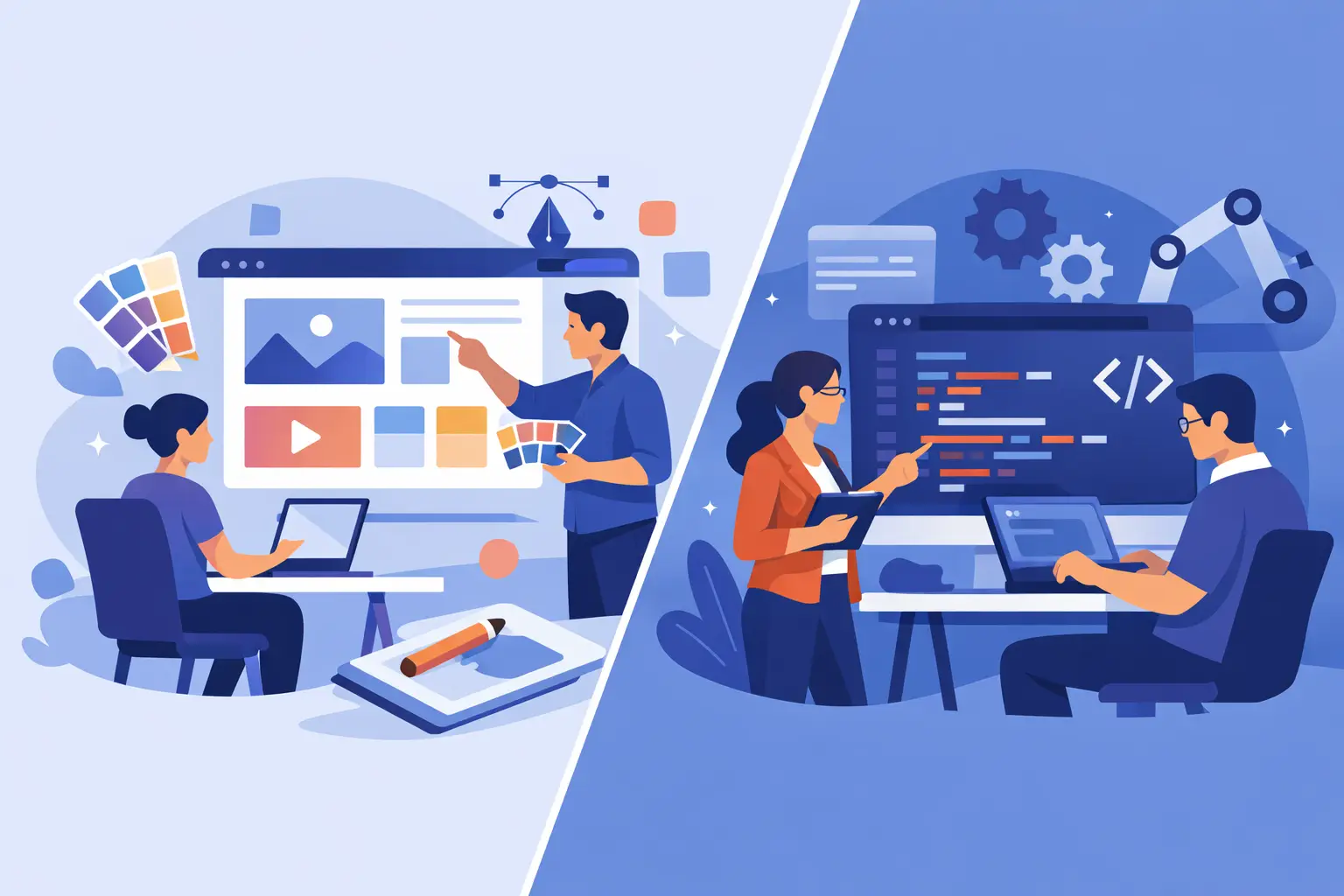
At the simplest level, web design focuses on the experience people have when they use your site. Web development focuses on building the site so that experience actually works.
Design is concerned with layout, branding, page structure, visual hierarchy, calls to action, mobile responsiveness from a user perspective, and the overall customer journey. A designer decides what visitors should see first, what they should do next, and how the site should support trust and conversion.
Development is concerned with code, functionality, performance, integrations, databases, forms, tracking setup, content management systems, and technical implementation. A developer takes the approved design and turns it into a working website.
That sounds clean on paper. In real projects, there is overlap. Some designers can build. Some developers have strong design instincts. Some platforms, especially no-code or low-code tools, blur the line even further. But the core distinction still matters because the thinking behind the work is different.
Web design is about communication and conversion
A good design is not decoration. It is decision-making.
When someone lands on your homepage, they are asking a few basic questions right away. What does this business do? Am I in the right place? Can I trust them? What should I do next? Design is what answers those questions quickly.
That includes your navigation, page layout, button placement, use of space, typography, imagery, color choices, service page structure, and the order in which information appears. For a home services company, that may mean putting service areas, financing options, and quote requests front and center. For a medical practice, it may mean making appointment scheduling and insurance information easy to find. For a restaurant, it may mean prioritizing menu access, hours, and location details.
Design also shapes usability. If your website looks polished but visitors cannot find the phone number, submit a form, or understand your services, the design failed.
This is where many business owners get misled. They think design means making a site look modern. Modern is fine. Useful is better.
What a web designer typically handles
A designer usually works on wireframes, mockups, user flow, page layouts, visual styling, brand consistency, and mobile behavior from the user side. In some cases, they also help with messaging structure because copy and design affect each other.
Strong web design is strategic. It is built around customer behavior, not personal taste.
Web development is about function and execution
If design decides what the house should look like and how people should move through it, development pours the foundation, frames the walls, and installs the systems.
A developer builds the actual website. That can include front-end development, which controls what users see and interact with, and back-end development, which handles server-side logic, data processing, user accounts, integrations, and more complex functionality.
Development covers the technical side of your website working the way it should. That includes page speed, form submissions, lead routing, CRM connections, ecommerce functionality, event tracking, search engine crawlability, security basics, browser compatibility, and responsive behavior across devices.
For a local business, development issues show up in very practical ways. A contact form stops sending leads. A location page breaks on mobile. A booking tool does not sync properly. A site looks fine on desktop but becomes frustrating on phones. Analytics are installed incorrectly, so nobody knows what is converting. Those are not design problems. They are development problems.
What a web developer typically handles
A developer usually manages site builds, theme customization, custom code, plugin setup, platform configuration, API integrations, technical QA, troubleshooting, hosting-related implementation, and performance improvements.
Good development is not just about making things work once. It is about making them work reliably.
Why the difference matters for your budget
This is where business decisions get clearer.
If your site already has solid functionality but looks dated, design may be the main need. If your site looks acceptable but has broken forms, slow load times, poor mobile performance, or limited functionality, development may be the bigger issue.
Often, businesses need both, but not in equal measure.
A company that relies on lead generation may need a conversion-focused redesign first, then development support to improve form handling, call tracking, and CRM integration. An ecommerce brand may need development-heavy work because checkout flow, inventory syncing, and product filtering affect revenue more directly than a visual refresh.
This is also why cheap website packages tend to disappoint. They often sell a design concept but underfund the development work, or they build functional pages with no real thought given to user behavior and conversion. Either way, the site underperforms.
The overlap is real, but the skill sets are still different
Some professionals do both well. Many do not.
A designer who works in Webflow, Shopify, or WordPress page builders may be able to produce excellent live pages without handing anything off to a separate developer. A developer with strong UX experience may make smart decisions about layout and user flow during implementation. That is common, especially in smaller projects.
But being able to move blocks around in a builder is not the same as understanding conversion strategy. And writing clean code is not the same as designing a page that earns trust and action.
That is the real difference between web design and development in practice. One centers on user experience and communication. The other centers on technical execution and functionality. You want both perspectives in the room, even if one person happens to cover both.
How to know what your business actually needs
Start with the business problem, not the website jargon.
If you are saying things like, “Our site looks old,” “It does not reflect the quality of our company,” or “People visit but do not take action,” you may have a design and messaging problem.
If you are saying, “Our forms break,” “The site is slow,” “We cannot update content easily,” “Tracking is a mess,” or “We need custom features,” you are likely dealing with a development problem.
If both sets of statements feel true, that is normal. Most established businesses outgrow their websites in multiple ways at once.
A practical website review should separate these issues instead of rolling them into one vague recommendation. That is especially important if you are investing in SEO, Google Ads, or content marketing. Sending paid traffic to a site with weak design or weak development is an expensive way to learn what was broken all along.
What to ask before hiring for web design or development
Before you sign anything, ask how the provider approaches structure, conversion, mobile behavior, speed, integrations, tracking, and ongoing updates. Ask who is actually doing the work. Ask what is custom versus template-based. Ask how content, SEO, and lead capture are handled during the build.
If someone talks only about visuals, they are probably design-heavy. If they talk only about code and platform features, they are probably development-heavy. Neither is automatically wrong, but you should know what you are buying.
For many small and mid-sized businesses, the best setup is working with someone who understands both sides and can tell you where to prioritize. That keeps the site tied to actual business goals instead of becoming a disconnected design exercise or a technical science project.
The real goal is not a prettier website
The goal is a website that helps your business grow.
That may mean clearer service pages, better calls to action, stronger local trust signals, faster load times, more reliable lead handling, cleaner analytics, or easier content management for your team. Design and development both contribute to that outcome, but they do not contribute in the same way.
If you understand that distinction, you make better decisions. You ask better questions. You stop paying for vague website work that sounds impressive and start investing in the pieces that actually move the business forward.
A good website is not just attractive or functional. It is aligned. When design and development work together, your site stops being an online brochure and starts doing its job.